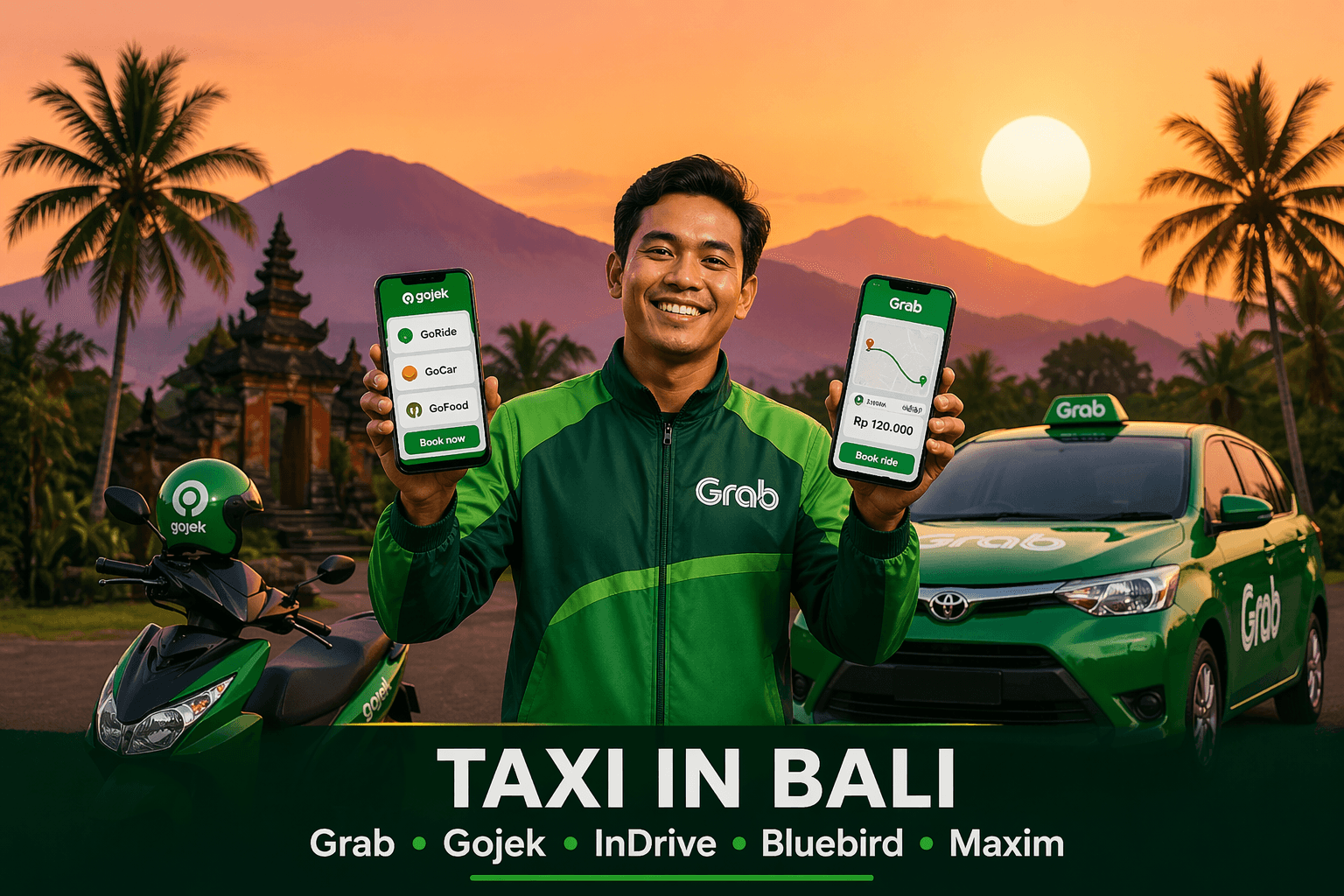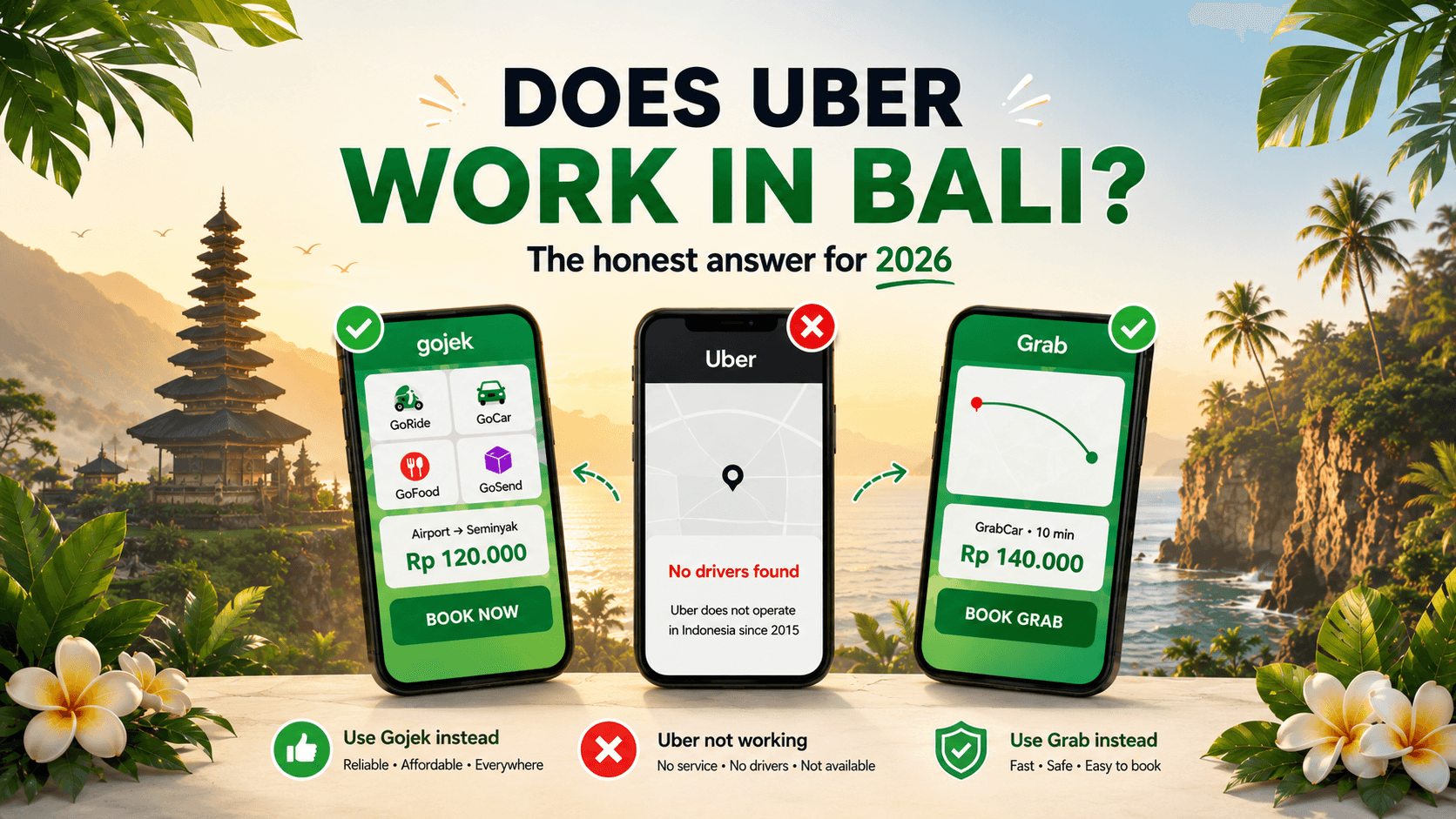
Uber in Bali 2026: Why It Doesn't Work and What to Use Instead — Grab, Gojek, InDrive, Bluebird & Maxim
Published
Why Uber doesn't work in Bali in 2026, when it left, and the 5 apps locals actually use. Real route prices, airport lounges at DPS, no-Gojek zones, payment tips, and scams to avoid. Written by a Bali resident.
Updated April 2026. Written by a Bali-based resident who uses these apps daily.
You land at Ngurah Rai International Airport (DPS), connect to airport Wi-Fi, open the Uber app to book a ride to Seminyak — and stare at an empty map. No drivers. No "no service in your area" message either, just a hopeful loading spinner that never stops. Welcome to Bali, where Uber stopped operating eight years ago and 95 % of new tourists find out the hard way. The good news — Bali has five ride-hailing apps that work better and cheaper than Uber ever did, and you can install them while still at the baggage carousel. The bad news — pick the wrong one, and you'll either wait 20 minutes for a driver or pay tourist-tax prices. Let's break it down properly.
Quick Answer for People in a Hurry
- Uber does NOT work in Bali, and it hasn't since April 2018, when Uber sold its entire Southeast Asian business to Grab.
- Direct Uber replacement is Grab. Same business model, same UX, and Grab actually owns the former Uber SEA operation.
- Local favorite is Gojek. Usually 10–20 % cheaper than Grab, more drivers across the south and center of Bali.
- Cheapest is InDrive. You name your own fare — often half of Grab — but cash only and fewer drivers.
- At DPS airport, walk to the Grab Lounge or Gojek Lounge on the right side after exiting international (near Circle K) — staff books the ride for you even without mobile data.
- Payment: foreign cards are hit-or-miss. Always keep Indonesian rupiah cash as backup. A local Permata, BCA or BNI card solves everything if you stay longer than a month.
- Don't trust street "taxi?" touts — they charge 3–5x the app price.
Why Uber Doesn't Work in Bali (and Probably Never Will Again)
The full story in one paragraph: Uber operated in Bali from 2014 to 2018. After burning roughly $700 million across Southeast Asia trying to compete with local players, Uber announced in March 2018 that it was selling its entire SEA business — Indonesia, Malaysia, Thailand, Vietnam, Singapore, the Philippines, Cambodia and Myanmar — to Singapore-based Grab. The deal closed on April 2, 2018. As part of it, Uber received a 27.5 % stake in Grab. So technically, when you book a Grab ride in Bali in 2026, you're partly using Uber. The brand just isn't called that anymore, and the app on your phone simply has no drivers registered in Indonesia.
Will Uber ever come back? Almost certainly not. Uber owns a chunk of Grab and would be competing with itself. Grab and Gojek now hold around 95 % of the Indonesian ride-hailing market combined. The unit economics that made Uber abandon SEA in 2018 haven't changed. So the first rule of ride-hailing in Bali in 2026: stop refreshing the Uber app, install Grab. It's the same product with a different logo, and it's been the standard for eight years.
Five Ride-Hailing Apps in Bali: Honest Comparison
Grab — The Direct Uber Replacement
Singapore-based super-app operating across Indonesia, Malaysia, Thailand, Vietnam, Singapore, and the Philippines. Owns Uber's former Southeast Asia business since April 2018. Same model as Uber: book a ride, see the price upfront, track the driver on the map, pay by card or cash.
Pros:
- Single account works across all Southeast Asia — convenient if Bali is part of a longer trip.
- At DPS airport, Grab has the most comfortable lounge with Wi-Fi.
- Registration with a US, EU, UK, AU or most Asian SIM works smoothly.
- Detailed tiers: JustGrab (any vehicle), GrabCar 6 (minivan), GrabCar Premium (cars less than 3 years old), GrabExpress for cargo and surfboards.
- The closest UX to Uber, including in-app SOS and Share My Ride.
Cons:
- Prices 10–20 % higher than Gojek on identical routes.
- Outside main tourist clusters, noticeably fewer drivers.
When to choose: when Gojek shows "no drivers," for airport runs, when you need a minivan for a group, when Bali is part of a longer SEA trip.
Gojek — The King of Bali
Think of Gojek as Indonesia's Uber-meets-DoorDash-meets-Amazon: cars (GoCar), motorbikes (GoRide), food delivery (GoFood), groceries (GoShop), parcels (GoSend), pharmacy, cleaning, massage. If you're staying longer than a week — Gojek is non-negotiable.
Pros:
- Lowest car-taxi prices among major apps.
- Broadest coverage across Bali: south, center, Ubud, Sanur, Nusa Dua, Canggu.
- GoBlueBird built in — call a classic Bluebird metered taxi directly from Gojek.
- GoPay e-wallet: top up in any Indomaret or Alfamart cashier in 30 seconds.
Cons:
- English-only interface (no local languages other than Bahasa).
- Binding a foreign card is a lottery. US/EU cards usually work. Cards from Russia, Kazakhstan, Belarus and Ukraine: about 50/50.
- Registration works best with a local SIM, though WhatsApp verification now accepts most foreign numbers.
When to choose: by default, always. In 90 % of cases Gojek delivers a car faster and cheaper than anything else.
InDrive — Name Your Price
Originally from Yakutsk (yes, Siberia), InDrive now operates in 47 countries. Gaining popularity on Bali since 2023.
Pros:
- You propose the fare — rides often 30–50 % cheaper than Grab or Gojek.
- Registration works with virtually any SIM card globally.
- Intercity tariff and ride-sharing with other passengers.
- Many drivers in Canggu, Seminyak, Sanur.
Cons:
- Cash payment only — no card binding.
- You have to haggle. Offer too little and no one accepts.
- In Ubud and on the east coast, few drivers.
- Minimalist interface, occasionally buggy.
When to choose: when you want to save and don't mind waiting 5–10 minutes for a driver to accept your offer. On short runs around Canggu or Sanur, InDrive often beats competitors by half.
Bluebird — The Trusted Classic
Bluebird has been running Indonesian taxis since 1972. Those blue cars with a white bird logo are the standard that Indonesians and expats trust. Uniformed drivers, clean cars, meter always on, no surprises.
Pros:
- Guaranteed service quality — English, AC, seatbelts, fixed meter rate.
- Dedicated MyBlueBird app, but easier to call via the GoBlueBird option inside Gojek.
- At DPS airport, the famous "Bluebird trick" still works (see airport section).
Cons:
- Fares 20–30 % higher than Grab and Gojek.
- Fewer cars — sometimes 15–20 minutes wait.
- Beware of fakes: other blue cars painted to look like Bluebird. Look for "Blue Bird Group" text and the bird silhouette logo on the door.
When to choose: when absolute predictability matters — traveling with kids or elderly parents, carrying valuables, needing a receipt for work reimbursement.
Maxim — Dirt-Cheap but...
Russian-origin ride-hailing service operating in Bali since 2022. Lowest prices of all.
Pros:
- Direct registration with any SIM, no virtual number tricks needed.
- Fares often 30–50 % below Grab and Gojek.
- Card binding works reliably.
Cons:
- Significantly fewer drivers, 10–20 minute waits are normal.
- Geolocation sometimes drifts — the driver may arrive at the wrong spot.
- Doesn't work at the airport or in "mafia" zones.
- Many drivers run Maxim alongside Grab and Gojek — they cherry-pick the highest-paying job, which means your cheap Maxim order may sit unaccepted.
When to choose: when you're in Sanur, Denpasar, or Nusa Dua and not in a rush. For airport transfers and Ubud trips, stick with Grab/Gojek.
Comparison Table: Which App Wins When
| Criterion | Grab | Gojek | InDrive | Bluebird | Maxim |
|---|---|---|---|---|---|
| Closest to Uber UX | ★★★★★ | ★★★★ | ★★★ | ★★ | ★★★ |
| Average price | 💰💰💰 | 💰💰 | 💰 | 💰💰💰💰 | 💰 |
| Driver count | ★★★★ | ★★★★★ | ★★★ | ★★★ | ★★ |
| Island coverage | South + center | South + center | South | South only | Sanur/south |
| Foreign SIM signup | Easy | Medium | Easy | Hard | Easy |
| Card payment | Hit-or-miss | Hit-or-miss | No | Yes | Yes |
| Works at DPS airport | ✅ Lounge | ✅ Lounge | ❌ | ⚠️ Trick | ❌ |
| Motorbike taxi | ✅ GrabBike | ✅ GoRide | ✅ | ❌ | ✅ |
| English interface | ✅ | ✅ | ✅ | ✅ | ✅ |
Bottom line: install both Grab and Gojek. Add InDrive for budget trips and Maxim as a backup. Call Bluebird through the GoBlueBird option inside Gojek. Forget Uber — it won't load drivers no matter what you try.
How Much Do These Apps Cost vs. Uber Was? Real 2026 Prices
Prices are for a car (GrabCar/GoCar) during regular hours, no surge. Motorbike taxis are 1.5–2x cheaper.
| Route | Distance | Grab | Gojek | InDrive | Street |
|---|---|---|---|---|---|
| Airport → Kuta | 3 km | 80–110K | 70–90K | 50–70K | 200–300K |
| Airport → Seminyak | 10 km | 120–160K | 100–140K | 70–100K | 250–400K |
| Airport → Canggu | 19 km | 160–210K | 140–180K | 100–130K | 350–500K |
| Airport → Ubud | 35 km | 230–310K | 200–280K | 150–200K | 500–700K |
| Airport → Nusa Dua | 15 km | 130–170K | 110–150K | 80–110K | 250–400K |
| Airport → Sanur | 13 km | 120–160K | 100–140K | 70–100K | 250–400K |
| Canggu → Seminyak | 6 km | 50–70K | 40–60K | 30–45K | 150–200K |
| Canggu → Ubud | 25 km | 160–220K | 140–190K | 100–140K | 350–500K |
| Seminyak → Ubud | 30 km | 200–260K | 170–230K | 120–170K | 400–600K |
| Ubud → Sanur | 30 km | 200–260K | 170–230K | 120–170K | 400–600K |
All prices in thousands of IDR (K = thousand). At current rate IDR 100K ≈ $6 USD / €5.5 / £4.8.
Important: Bali rides are about 60–70 % cheaper than equivalent Uber rides in the US or Europe. A 10 km Grab ride costs $6–10. The same distance in Uber NYC would be $25–35. So even though Uber doesn't operate here, your transport budget will feel like a luxury upgrade.
Extras that may be added to the app price:
- Airport entry/exit toll: IDR 10,000 (paid by passenger in cash).
- Bali Mandara Toll Road: IDR 10,000–15,000 if crossing the Nusa Dua bridge.
- Parking at temples/beaches: IDR 5,000–10,000 per stop.
- Tips: IDR 5,000–20,000 — optional but appreciated, especially for app-booked rides since drivers earn less than what shows on your screen after the platform's cut.
"Where's My Uber?" — Getting from DPS Airport in 2026: Step-by-Step
This is the single biggest panic moment for first-timers landing in Bali. You open Uber, see no drivers, and a wall of touts shouts "Taxi! Taxi, my friend!" at you. Here's what to do instead.
Option 1. Pre-Booked Transfer (Recommended for First Arrival)
If you're landing in Bali for the first time, at night, with kids or heavy luggage — book a transfer in advance via Klook, GetYourGuide, Welcome Pickups or a local operator. Price: $10–25 to anywhere on the island. A driver meets you with a name sign, handles your bags, and drives you without you needing to navigate. You pay $3–7 more than Grab, but save your nerves.
Option 2. Grab Lounge and Gojek Lounge (New since 2024)
Exit the DPS international terminal, walk right past Starbucks and Circle K — about 150–200 meters. On your right, you'll see covered waiting areas with Grab and Gojek logos. Inside: a staff member with a tablet, free Wi-Fi, AC.
What to do:
- Tell the staff your destination.
- They book the ride in their app or help you book in yours.
- You get a car number and pickup spot.
- The driver pulls up at the designated parking area next to the lounge.
- Pay in cash or by card (if your card is bound).
The price includes a ~IDR 10,000 airport fee plus a ~30 % surge — still 2–3 times cheaper than street touts, and considerably cheaper than what Uber would have charged here.
Option 3. The Bluebird Trick (For the Savvy)
Official Bluebird taxis aren't allowed to pick up from the arrivals area — the airport taxi syndicate blocks them. But they are allowed to drop off departing passengers. The trick:
- Go up the ramp to the Departures level (one floor up).
- Wait for a blue car with "Blue Bird Group" text that just dropped off a passenger.
- Get in; the driver starts the meter.
As of 2026 the trick still works. Metered fare to Seminyak is about IDR 100,000–130,000, to Ubud about IDR 250,000–300,000 — comparable to Grab but with guaranteed quality service.
Option 4. InDrive (For the Ultra-Budget)
Walk 400–500 meters from the terminal building, drop your pin near the Domestic Area parking or on Jalan Raya I Gusti Ngurah Rai. Offer a fare 30 % below Gojek's quote. Usually someone accepts within 2–5 minutes.
What NOT to Do
- Don't keep refreshing the Uber app — it will not load drivers in Indonesia, ever.
- Don't accept "taxi?" offers from touts near the exit — these are the same drivers with 3x markup.
- Don't trust "Uber Bali" sites that pop up in Google. There are scammy pages pretending to be "Uber for Bali" that take your card details and give nothing. The real apps are Grab, Gojek, InDrive, Maxim, Bluebird. Period.
- Don't hand over your passport or pay upfront — legitimate drivers never ask for this.
- Don't pay the "lost ticket fine" of IDR 50,000 at the airport exit gate. The real exit fee is IDR 10,000, printed on the ticket. This is a classic scam.
Registering Grab and Gojek with a Foreign SIM (the "Where Was Uber Easier" Comparison)
The one place Uber genuinely was easier: registration. With Uber, your existing account just worked anywhere. Grab and Gojek require some setup. In 2026, both accept most foreign phone numbers via SMS or WhatsApp verification.
Grab
- Download the app (Google Play / App Store).
- Enter your phone number with country code.
- Enter the SMS code. If it doesn't arrive in 60 seconds, request again or switch to WhatsApp verification (since 2024).
- Add a card or leave "Cash" as default.
If SMS stubbornly refuses to come, buy an Indonesian virtual number on sms-man.com, sms-activate.org or similar services — costs about $0.50. You get an Indonesian number, register, then change your profile number back to your real one.
Gojek
Historically stricter with foreign numbers, but since late 2024 also supports WhatsApp verification. Same flow: number → SMS or WhatsApp code → account. Virtual number workaround works identically.
Binding a Bank Card
Situation as of April 2026:
- US, EU, UK, AU cards (VISA/Mastercard) — work reliably (just like with Uber).
- Wise, Revolut, N26 — work almost always.
- Cards from Russia, Belarus, Ukraine — usually fail due to sanctions.
- Cards from Kazakhstan, Kyrgyzstan, Armenia — work about 50 % of the time. Sometimes calling your bank to "enable international payments in Indonesia" unblocks them.
- Indonesian bank cards (Permata, BCA, BNI) — work always. Best option if you stay longer than a month (opening an account requires a KITAS visa).
If your card won't bind — don't panic. Cash payment works in every app except InDrive (where it's cash by default). Always carry IDR 200,000–500,000 in small notes (20K, 50K, 100K) — drivers rarely have change from a 100K bill.
Motorbike Taxi in Bali: The "Uber Moto" of Southeast Asia
GrabBike and GoRide are a cheap, fast option for solo riders with a backpack. There's no Uber equivalent in the West that's quite this cheap or this common.
Price: 1.5–2x cheaper than a car. Short hop around Canggu: IDR 10,000–20,000 (about $0.60–1.20). Airport to Kuta: IDR 30,000–40,000.
When to pick a bike:
- You're solo, no suitcase.
- Rush hour traffic (and Bali traffic ranges from mild to catastrophic).
- A quick "store and back" trip.
- You want the real Bali feel.
When NOT to pick a bike:
- Rain or chance of rain (wet season November–March).
- Large luggage or a suitcase.
- Ride longer than 30 minutes — your back will regret it.
- Kids under 5.
- Night rides on unlit roads.
Safety. The driver gives you a helmet — wear it. Indonesian police fine riders without helmets regardless of whether you're the tourist passenger. Keep your backpack in front of you, not on your back — it's proper etiquette and safer.
"No-Gojek Zones": Where Apps Don't Work and How to Bypass
This is the one quirk of Bali ride-hailing that didn't exist in Uber's day — in fact it's part of why Uber struggled here. Bali operates under "banjar" (village) rules: each community has the right to regulate its internal transport. As a result, in several places the local taxi union prohibits Grab/Gojek pickups. If you try to book — the driver either cancels or asks you to walk 200–500 meters away.
Main gray zones in 2026:
- Central Ubud (especially Jl. Raya Ubud, Monkey Forest Road, the market).
- Uluwatu and around the temple.
- Touristy beach sections at Pandawa, Melasti, Suluban.
- Central Canggu (Batu Bolong, Berawa — partially).
- Tanah Lot Temple.
- Tegalalang and Jatiluwih rice terraces.
- Villages around Lake Batur (Kintamani).
- Padang Bai (Gili and Lombok ferry port).
- Northern Lovina and Pemuteran (online taxis barely work at all).
- East coast: Amed, Candidasa (pickups possible but cars scarce).
How to work around them:
- Pickup: walk 300–500 meters from the "controlled" zone (main street, temple parking, market). Drop your pin where there are no "Online Taxi Prohibited" signs.
- Drop-off: ask the driver to drop you 100–200 meters before your actual destination. Walk the rest.
- In the app chat write upfront: "I know this is sensitive area, I will walk to the main road" — drivers appreciate informed passengers and accept more readily.
- Return trip: if you arrived at a temple/waterfall via an app — arrange with the driver to wait 1–2 hours for an extra fee (usually IDR 50,000–100,000). Cheaper than catching a ride back at the spot.
- For far-flung destinations (Amed, Lovina, Batur, the north), just hire a private driver for the day — see next section.
Private Driver for a Day: When It Beats Apps
Bali is an island where sights are scattered. If your plan is "temple → waterfall → rice terraces → luwak coffee farm," ordering a separate Grab for each stop costs more and stresses more than hiring a private car. There's no Uber equivalent for this — it's the local way and it works beautifully.
Full-day driver (8–10 hours) pricing:
- South (Kuta, Seminyak, Canggu, Nusa Dua): IDR 550,000–750,000 ($33–45).
- Medium tours including Ubud: IDR 700,000–900,000 ($42–55).
- Long-distance (Lovina, Amed, West Bali, Menjangan): IDR 900,000–1,500,000 ($55–90).
Fuel, parking, and water are typically included. Entrance fees and meals are on you. A tip of IDR 50,000–100,000 is a welcome thank-you.
Where to find one:
- Your hotel or villa (they almost always have a trusted driver on call).
- Klook, GetYourGuide, Viator — higher cost but pre-booked, reviewed, and reliable for first-time visitors.
- Grab Rent or Gojek GoCar Rent inside the apps — hire from 4 hours up.
- Local Facebook groups ("Bali Expats", "Canggu Community") — look for driver recommendations.
Common Bali Ride Scams and How to Avoid Them
- The "lost ticket" fine at airport exit. The taxi driver takes the entry ticket. At the exit gate he claims there's a IDR 50,000 "lost ticket penalty." Real exit fee: IDR 10,000 (printed on the ticket). Ask to see the ticket — he'll suddenly "remember."
- Fake Gojek/Grab driver. A street tout dons a green jacket and pulls up while you wait for your real ride. He then charges 3–5x the app price. Always verify the car number and driver's name against what's shown in the app.
- "Uber Bali" scam websites. Fake sites pretending to be "Uber for Bali" pop up in Google ads — they collect your card details and book nothing. The only legitimate apps are Grab, Gojek, InDrive, Maxim, Bluebird. Uber doesn't have any "regional partner" or "local Uber" arrangement in Indonesia.
- "Meter is broken." Classic excuse from street taxis and fake Bluebirds. Once you agree to negotiate, you'll pay their "from the head" rate.
- Phantom "toll road" on routes that have no toll. Or an inflated entry fee to a temple/beach, allegedly "paid on your behalf."
- "We broke down / road is closed." The driver gets you halfway, demands extra, threatens to kick you out.
- Fake Bluebird. Other blue cars without the bird logo. Real ones say "Blue Bird Group" on the door and issue a printed receipt.
Universal rule: any situation where the driver "suddenly remembers" something mid-ride or at the end is a scam. Pay only the amount agreed upfront or shown in the app.
Bottom Line: How to Get Around Bali in 2026 (Without Uber)
- Stop refreshing Uber. Install Grab + Gojek + InDrive before you fly.
- Register with your home SIM — in 2026 this mostly works.
- Pre-book your airport transfer or head straight to the Grab Lounge at DPS.
- For daily rides around the south, default to Gojek. To save, use InDrive.
- In "gray zones," walk 300–500 meters and book from there.
- For sightseeing days, hire a private driver (via hotel or expat chats).
- Carry rupiah cash — card binding is sometimes flaky.
- Never trust street "taxi" touts at the airport or temples.
With this playbook, Bali in 2026 is a welcoming, predictable island — even without Uber. Comfortable $6 rides, polite drivers with their "Selamat pagi" smile, fixed fares in the app. The Uber-shaped hole on your phone disappears the moment you open Grab for the first time and realize the ride costs less than your morning latte back home.
If this guide helped — share it with friends planning their Bali trip and still asking "does Uber work there?". Safe travels, and don't forget to tip your driver. They earn less than you'd think, and they'll remember you.
Useful Links
- Download Grab: App Store / Google Play
- Download Gojek: App Store / Google Play
- Download InDrive: App Store / Google Play
- Download Maxim: App Store / Google Play
- MyBlueBird: use the GoBlueBird option inside Gojek
Also Read
- Taxi in Bali 2026: complete guide — Grab, Gojek, InDrive, Bluebird & Maxim
- How to rent a scooter in Bali
- Best time to visit Bali: monthly weather
- Bali visa guide 2026