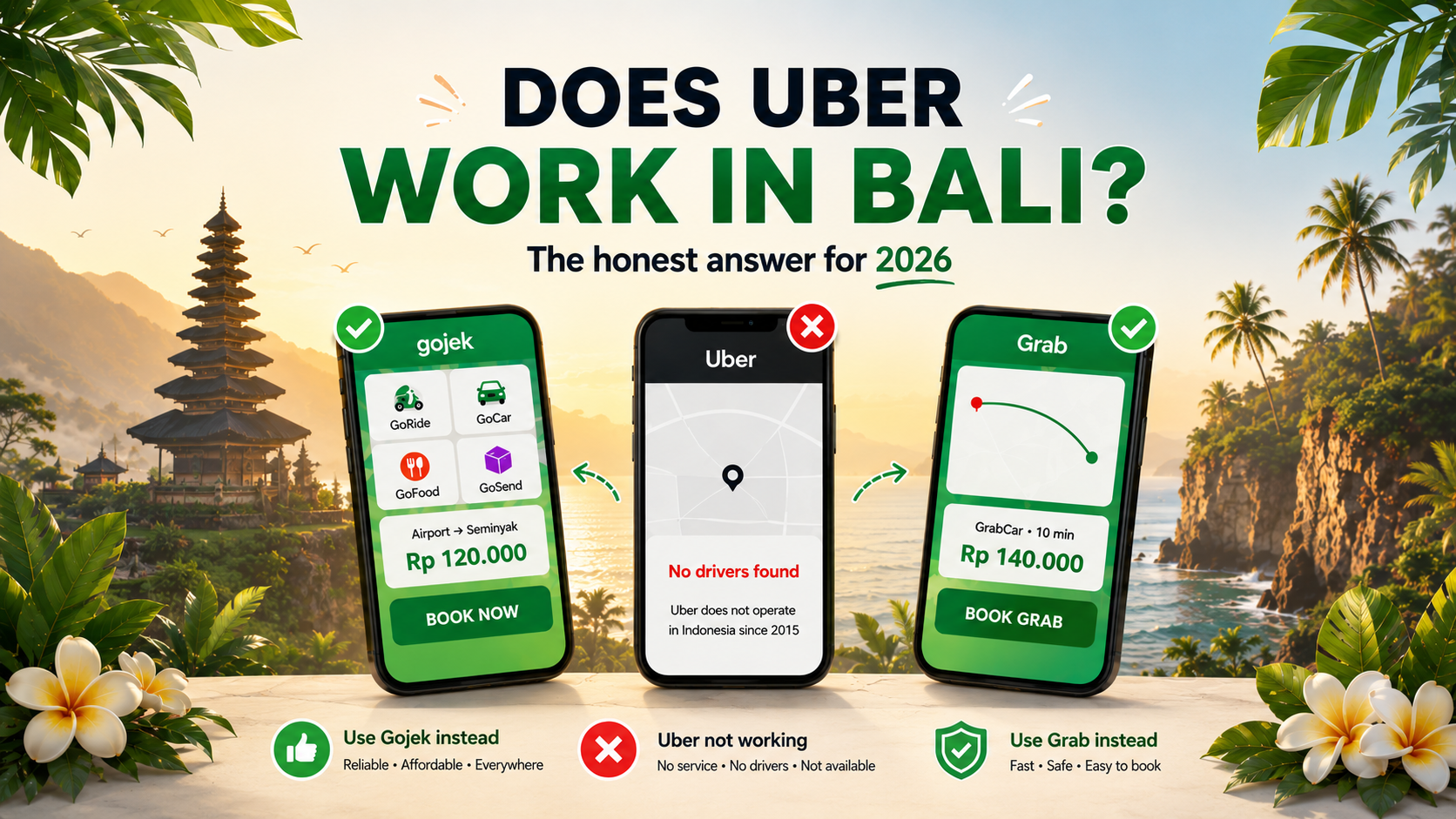
2026年巴厘岛的Uber:为什么它不起作用以及可以使用的替代方案——Grab、Gojek、InDrive、Bluebird和Maxim
Published
发现2026年巴厘岛的Uber为何不再可用,了解Grab、Gojek、InDrive、Bluebird和Maxim等替代方案的优势。
Updated in April 2026. Written by a Bali local who uses these apps every day.
So you just landed in Bali and the first thing you do is reach for your phone to fire up Uber and book a ride to Seminyak. But wait—your screen just shows an empty map with no drivers and no “Service unavailable” message. Just that annoying loading icon going in circles. Welcome to Bali! Since Uber pulled out eight years ago, this is a surprise for about 95% of new visitors. But hey, don’t worry, I’ve got great news: Bali now has five ride-hailing apps that are even better and cheaper than Uber. You can download them while you’re waiting at the baggage carousel. The catch? Pick the wrong one and you might be waiting 20 minutes for a ride or paying extra tourist prices. Let me guide you through it.
Quick Guide: If You’re in a Hurry
- No Uber in Bali: Uber stopped operating here back in April 2018 after selling its Southeast Asia business to Grab.
- Grab is your Uber replacement. Same business model, similar user experience, and it actually owns what used to be Uber’s Southeast Asia operation.
- Local favorite is Gojek. Generally 10-20% cheaper than Grab and with more drivers in southern and central Bali.
- InDrive is the cheapest. You set the price—usually about half of Grab’s rate—and pay cash only, but there are fewer drivers.
- At DPS Airport, head right out of the exit to the Grab Lounge or Gojek Lounge near Circle K—staff can help you book a ride even without mobile data.
- Payment tips: Foreign bank cards can be hit-or-miss. It’s smart to have some Indonesian rupiah cash on you. If you’re staying more than a month, getting a local Permata, BCA, or BNI card can save you a ton of hassle.
- Don’t trust the street guys asking “taxi?”—they’ll charge you about 3-5 times what you’d pay through an app.
Why You Can’t Use Uber in Bali (And Probably Never Will Again)
Here’s the scoop: Uber operated in Bali from 2014 to 2018. After spending about $700 million trying to compete with local players in Southeast Asia, Uber announced in March 2018 that it would sell its entire Southeast Asia business—including Indonesia, Malaysia, Thailand, Vietnam, Singapore, the Philippines, Cambodia, and Myanmar—to Singapore-based Grab. The deal closed on April 2, 2018, with Uber getting a 27.5% stake in Grab. So when you book a Grab in Bali in 2026, you’re kind of using Uber. Just with a different name and no drivers registered on the Uber app in Indonesia.
Will Uber make a comeback? Almost certainly not. Since Uber owns a stake in Grab, coming back would mean competing against itself. Grab and Gojek now hold about 95% of Indonesia’s ride-hailing market. The economics that pushed Uber out in 2018 haven’t changed. So, rule number one for getting around Bali in 2026: Quit refreshing Uber and download Grab. It’s the same product with a new logo and has been the go-to for the past eight years.
Bali’s Five Ride-Hailing Apps: An Honest Comparison
Grab—The Direct Uber Replacement
Think of Grab as the super app from Singapore that covers Indonesia, Malaysia, Thailand, Vietnam, Singapore, and the Philippines. It’s been running the former Uber Southeast Asia business since April 2018. Same model as Uber: book a ride, get transparent pricing, track your driver, pay with a card or cash.
Pros:
- One account works across multiple Southeast Asian countries—handy if Bali is just one stop on your trip.
- At DPS airport, Grab has the comfiest lounge with Wi-Fi.
- Easy registration with SIM cards from the US, Europe, UK, Australia, or most of Asia.
- Detailed options: JustGrab (any vehicle), GrabCar 6 (minivan), GrabCar Premium (new cars), and GrabExpress for goods or surfboards.
- Closest to the Uber experience with in-app SOS and trip-sharing features.
Cons:
- Prices are 10-20% higher than Gojek.
- Fewer drivers outside major tourist areas.
When to choose: When Gojek shows "no drivers," for airport trips, if you need a minivan, or if Bali is part of a longer Southeast Asian journey.
Gojek—The King of Bali
Picture Gojek as Indonesia’s Uber plus DoorDash plus Amazon: car rides (GoCar), motorcycle rides (GoRide), food delivery (GoFood), groceries (GoShop), packages (GoSend), pharmacy, cleaning, and massage services. Whether you’re staying a week or longer, Gojek is a must-have.
Pros:
- The lowest ride prices among major apps.
- Best coverage across Bali: South, Central, Ubud, Sanur, Nusa Dua, Canggu.
- Built-in GoBlueBird—call classic Bluebird metered taxis directly through Gojek.
- GoPay e-wallet: reloadable at any Indomaret or Alfamart in 30 seconds.
Cons:
- English interface only (besides Indonesian).
- Risky to bind foreign cards. US/EU cards usually work. Russian, Kazakh, Belarusian, and Ukrainian cards have about a 50% chance of success.
- Best to register with a local SIM card, though WhatsApp verification now accepts most foreign numbers.
When to choose: This is your default choice. In 90% of cases, Gojek will be faster and cheaper.
InDrive—Set Your Own Price
Originating from Yakutsk (yes, Siberia), InDrive now operates in 47 countries and has been gaining traction in Bali since 2023.
Pros:
- You set the fare—usually 30-50% cheaper than Grab or Gojek.
- Register with almost any global SIM card.
- Inter-city rates and options to carpool with other passengers.
- Plenty of drivers in Canggu, Seminyak, and Sanur.
Cons:
- Cash payment only—no credit card binding.
- You’ll need to negotiate. Too low a bid means no takers.
- Fewer drivers in Ubud and the East Coast.
- Minimalist interface with occasional bugs.
When to choose: When you want to save money and don’t mind waiting 5-10 minutes for a driver to accept your offer. InDrive often beats competitors by half in short runs around Canggu or Sanur.
Bluebird—The Trusty Classic
Bluebird has been running Indonesia’s taxis since 1972. Those blue cars with the white bird logo are the go-to for locals and expats alike. Uniformed drivers, clean cars, always-on meters—no worries.
Pros:
- Reliable service—English-speaking, air-conditioned, seatbelts, fixed metered fare.
- Dedicated MyBlueBird app, but easier to call through the GoBlueBird feature in Gojek.
- At DPS Airport, the famous “Bluebird trick” still works (see the airport section).
Cons:
- Fares are 20-30% higher than Grab and Gojek.
- Fewer cars—sometimes a 15-20 minute wait.
- Beware of fakes: other blue cars painted to look like Bluebird. Look for “Blue Bird Group” text and bird logo on the doors.
When to choose: When predictability is crucial—traveling with kids or elderly parents, carrying valuables, need a work receipt.
Maxim—Super Cheap but...
Maxim, a Russian-origin ride service, has been operating in Bali since 2022. It offers the lowest prices of all apps.
Pros:
- Register with any SIM card, no virtual number needed.
- Fares usually 30-50% lower than Grab and Gojek.
- Reliable card binding.
Cons:
- Noticeably fewer drivers, with 10-20 minute waits common.
- Location drift can occur—drivers might arrive at the wrong place.
- Doesn’t work in the airport or “mafia” zones.
- Many drivers run both Maxim and Grab or Gojek—meaning your cheap Maxim order might get ignored.
When to choose: When you’re in Sanur, Denpasar, or Nusa Dua and not in a rush. For airport pickups and trips to Ubud, stick with Grab/Gojek.
Comparison Table: When Each App Wins
| Criteria | Grab | Gojek | InDrive | Bluebird | Maxim |
|---|---|---|---|---|---|
| Closest to Uber’s user experience | ★★★★★ | ★★★★ | ★★★ | ★★ | ★★★ |
| Average Cost | 💰💰💰 | 💰💰 | 💰 | 💰💰💰💰 | 💰 |
| Number of Drivers | ★★★★ | ★★★★★ | ★★★ | ★★★ | ★★ |
| Island Coverage | South + Central | South + Central | South | South Only | Sanur/South |
| Foreign SIM Registration | Easy | Moderate | Easy | Tricky | Easy |
| Card Payment | Hit or Miss | Hit or Miss | None | Yes | Yes |
| Available at DPS Airport | ✅ Lounge | ✅ Lounge | ❌ | ⚠️ Trick | ❌ |
| Motorbike Taxis | ✅ GrabBike | ✅ GoRide | ✅ | ❌ | ✅ |
| English Interface | ✅ | ✅ | ✅ | ✅ | ✅ |
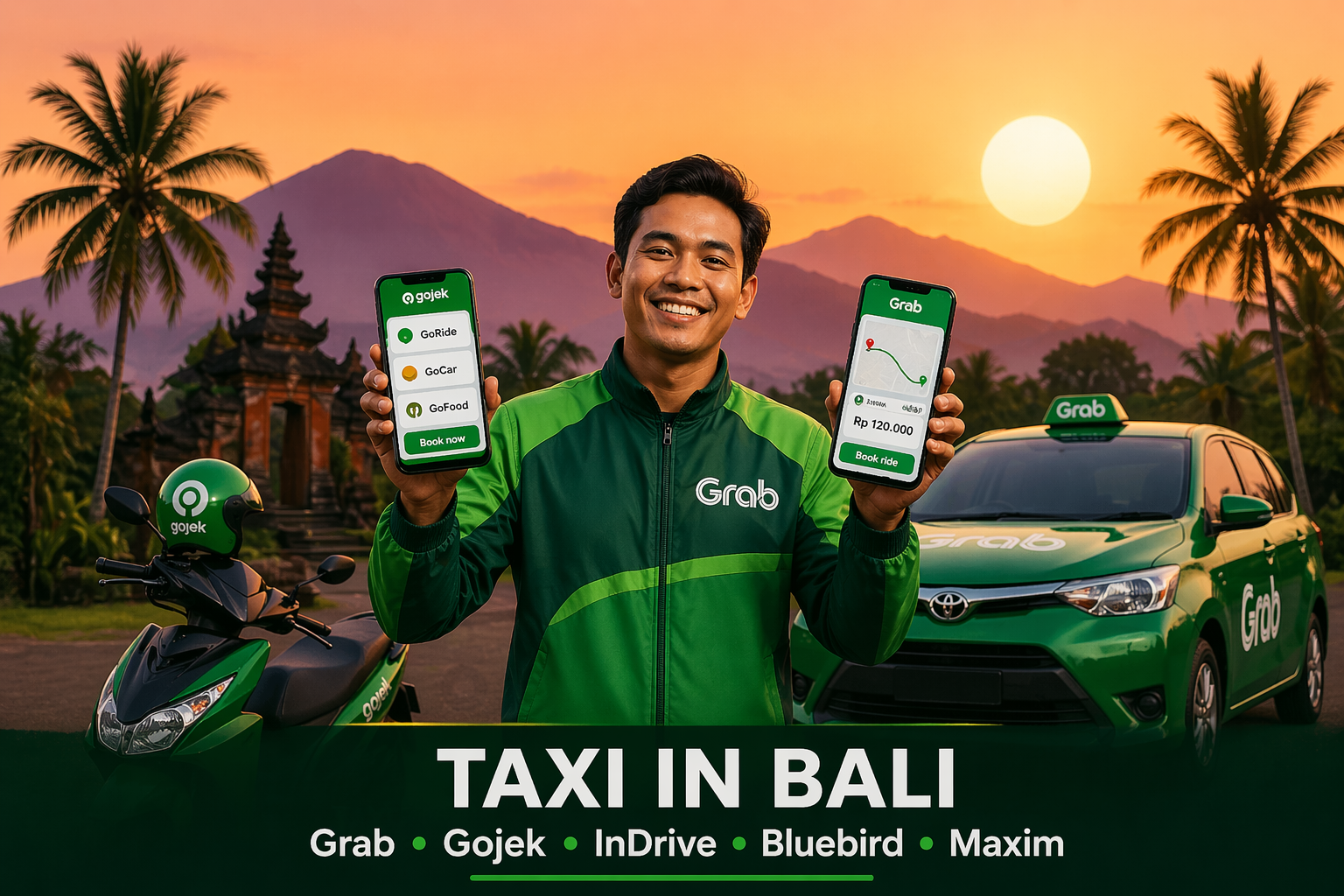
Summary: Install Grab and Gojek. Add InDrive for budget travel, Maxim as a backup. Use the GoBlueBird option in Gojek to call Bluebird. Forget about Uber—no matter how much you try, no drivers will appear.
How Do These Apps’ Prices Compare to Uber Back in the Day? Real 2026 Prices
Prices are for standard-time sedan rides (GrabCar/GoCar), excluding peak-time surcharges. Motorbike taxis are 1.5-2 times cheaper.
| Route | Distance | Grab | Gojek | InDrive | Street Hail |
|---|---|---|---|---|---|
| Airport → Kuta | 3 km | 80–110K | 70–90K | 50–70K | 200–300K |
| Airport → Seminyak | 10 km | 120–160K | 100–140K | 70–100K | 250–400K |
| Airport → Canggu | 19 km | 160–210K | 140–180K | 100–130K | 350–500K |
| Airport → Ubud | 35 km | 230–310K | 200–280K | 150–200K | 500–700K |
| Airport → Nusa Dua | 15 km | 130–170K | 110–150K | 80–110K | 250–400K |
| Airport → Sanur | 13 km | 120–160K | 100–140K | 70–100K | 250–400K |
| Canggu → Seminyak | 6 km | 50–70K | 40–60K | 30–45K | 150–200K |
| Canggu → Ubud | 25 km | 160–220K | 140–190K | 100–140K | 350–500K |
| Seminyak → Ubud | 30 km | 200–260K | 170–230K | 120–170K | 400–600K |
| Ubud → Sanur | 30 km | 200–260K | 170–230K | 120–170K | 400–600K |
All prices are in thousands of Indonesian Rupiah (K = thousand). Current exchange rate: 100K IDR ≈ $6 / ~€5.5 / ~£4.8.
Pro Tip: Bali’s ride-hailing costs are about 60-70% lower than Uber in the US or Europe. A 10 km ride with Grab will set you back $6-10. In NYC, a similar Uber ride would cost $25-35. So even without Uber running here, your transport budget feels like a luxury upgrade.
Extra charges that app prices might include:
- Airport entry/exit fee: IDR 10,000 (cash paid by the passenger).
- Bali Mandara Toll Road: If crossing the Nusa Dua bridge, it’s IDR 10,000–15,000.
- Temple/beach parking: Charges vary by location.